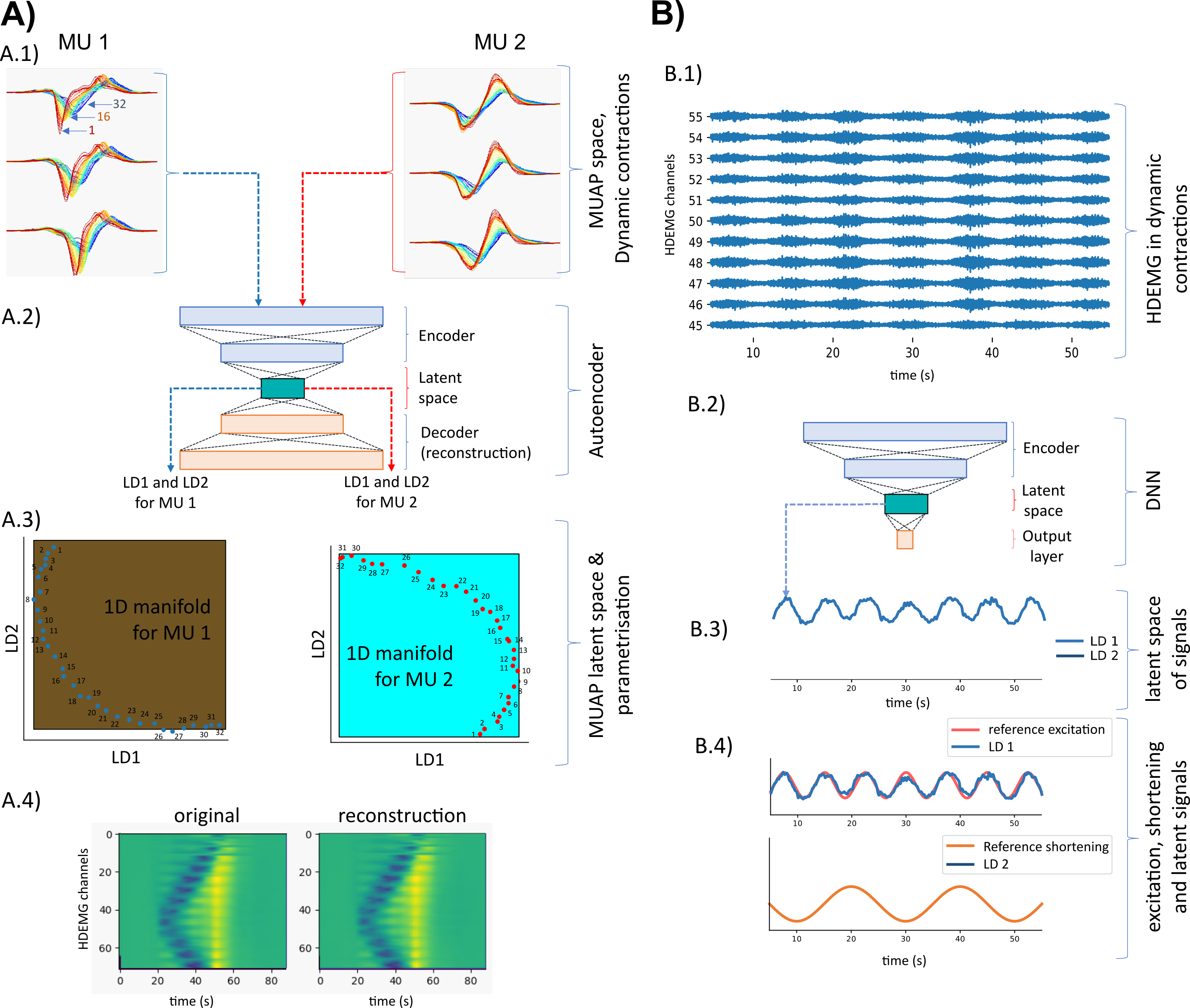
The extraction of information from noninvasively recorded high-density electromyography (HDEMG) is gaining importance, providing the fundaments for understanding neurophysiological mechanisms and prevention, prognosis, diagnosis and treatment of numerous neuromuscular disorders. HDEMG electrodes can be placed on the skin and embedded into smart clothes or epidermal electronics, making signal acquisition completely unobtrusive. However, the acquired HDEMG signals pose considerable challenges to their analysis:
- Currently, several tens of HDEMG channels per individual skeletal muscle are recorded, supporting the robustness to bad skin-electrode contacts and mathematical decomposition of recorded HDEMG into contributions of individual physiological sources, e.g. motor units (MUs). However, existing signal analysis techniques are not yet capable of identifying the optimal compromise between the quality of extracted information and the required number of HDEMG channels per muscle.
- In dynamic and fatiguing contractions, volume conductor properties, separating the physiological sources and HDEMG uptake electrodes, are continuously changing, hindering the discrimination of muscle excitation commands from peripheral changes of the volume conductor. This leads to considerable misinterpretation of HDEMG measurements.
- Modelling the changes of muscle tissue in dynamic and fatiguing contractions is complex and depends on the properties of individual muscles. Existing simulators simplify the complexity and heterogeneity of subcutaneous tissue and do not generate fully representative MU action potentials (MUAPs), especially in dynamic and fatiguing contractions.
- Positioning of the electrodes on the skin's surface is not standardised, and the proposed acquisition systems demonstrate large variability in the number, size and positioning of the uptake electrodes. It is not clear to what extent generative artificial intelligence (AI) can be used to repair noisy or generate missing HDEMG channels.
We recently demonstrated that it is possible to track MUAP changes in dynamic and fatiguing contractions, but the existing techniques are computationally intensive. Our preliminary results demonstrate that MUAP changes can be successfully addressed in low-dimensional latent spaces of deep neural networks (DNNs). However, the required dimensionality of latent spaces, the optimal DNN architecture and the datasets required for efficient, unbiased and trustworthy DNN training in different scenarios (e.g., dynamic or fatiguing contractions) are largely missing.
In this project, we propose to investigate and answer the following research questions:
- What is the optimal DNN architecture for extracting information about muscle excitation and MUAP changes from the HDEMG signals, and what are their optimal training sets?
- To what extent are the DNNs capable of separating the muscle excitation profiles (commands of the central nervous system) from the electrical changes in the volume conductor (i.e. peripheral properties)?
- How do the changes of volume conductor demonstrate in the latent spaces of DNNs, and which latent spaces support efficient prediction/extrapolation of volume conductor changes?
- What is the variability of information stored in the latent spaces of DNNs and accumulated across different movements and persons?
- To what extent can inter-sessional, inter-personal and inter-movement translation learning of DNNs on HDEMG be implemented?
- To what extent can the DNNs and generative AI increase the robustness of information extraction to missing/bad HDEMG channels?
All these questions will be addressed by exploiting our knowledge about a-nalysing HDEMG signals and methodologies for decomposing HDEMG in isometric, dynamic and fatiguing muscle contractions.
The project is conducted by researchers at the Faculty of Electrical Engineering and Computer Science (UM FEECS) of the University of Maribor, Slovenia and the Science and Research Centre Koper (SRC Koper), Slovenia. We collaborate with external partners from Loughborough University (LU), Leicestershire, UK, and Imperial College London (ICL), UK.